Prior
to gold
dollars being issued in 1849, private minters supplied
miners with a means of converting their oar and gold dust
into currency. However, since the coins produced were variable
in fineness and often counterfeited, a bill was introduced
in 1844 for the government to make gold dollars. Mint Director
Robert Patterson was opposed. He lied when he claimed that
there was no public demand for these Gold
Dollar coins. The truth is that Patterson did not want
James Longacre making new dies because it might interfere
with his friend Franklin Peale’s medal-making business
that was being run out of the Mint. Patterson hoped that Longacre’s
job would be abolished if new coinage was not needed. Despite
Patterson’s objections, Longacre prevailed and made
the new dies for the gold
dollar. It became an alternative to the silver dollar.
James B. Longacre designed
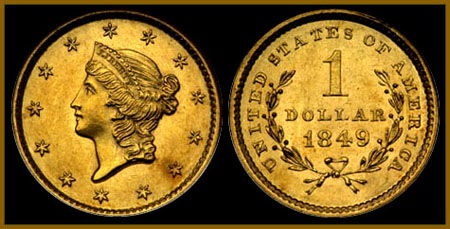
three gold dollar types. The first was the Liberty Head that
was minted from 1849 to 1854. The obverse shows Liberty facing
left. On her head is a coronet inscribed LIBERTY in incuse
letters. Her hair is combed back into a hair knot. Loose hair
encircles her head beneath the coronet, and several curls
hang down her neck. Encircling her head are thirteen six-pointed
stars. Dentils are near the edge on both sides of the coin.
The reverse has an open wreath of berries tied in a bow at
the bottom. A large numeral one is near the top. The word
DOLLAR is underneath, and the date is below the denomination.
The inscription UNITED STATES OF AMERICA is in an arc around
the wreath. The mintmark is below the knot of the bow.
One thousand coins were struck
on May 8, 1849. Today these are known as the No L variety
because Longacre’s initial did not appear on the coin.
Since the dies quickly cracked, new ones were prepared with
the motif slightly redesigned. Most Type
1 gold dollars were struck in Philadelphia. These are
the most common coins of the type today. They were also minted
in the branch mints, Charlotte, Dahlonega, New Orleans, and
San Francisco. The coins from these mints are much rarer than
those of Philadelphia. The 1849-C Open Wreath gold dollar
is the rarest with only four examples known today. While most
dates and mints are available in circulated condition, only
Philadelphia specimens are easily obtainable in mint state.
Varieties include the 1849
(Philadelphia) Open and Close Wreath, Small and Large Head,
With L and No L; the 1849-C Open and Close Wreath; and the
1849-D and O with Open Wreath. Proof Type 1 gold dollar coins
are almost non-existent with only 2 known from 1850.
Found with Open and Closed Wreaths on the reverse, plus
varieties with smaller heads and with or without the designer's
initial "L" on the bust line. Rare above MS64.
2 proofs known.
Found
with Open and Closed Wreaths on the reverse. The Open
Wreath version is extremely rare, known as the “king”
of the gold dollars. Closed Wreath rare in Mint State.