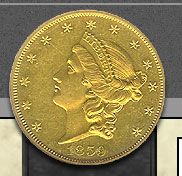
Southern gold coins were
struck at the Dahlonega, Charlotte Mint between 1838 and
1861 and at the New Orleans mint from 1839 to 1861, and
again from 1879 through 1909.
The discovery of gold in the Southeast
sparked the opening of mints in Dahlonega (Georgia) and
Charlotte (North Carolina) in 1838. Also in 1838, a mint
was opened in New Orleans, Louisiana, to facilitate commerce
in the new states and to convert the steady stream of world
coins that were entering the city.
Several of the mints fell
victim to circumstances beyond their control. For instance,
in 1861, Confederate forces seized the Charlotte, Dahlonega,
and New Orleans mints. The first two mints were shut down
as a result, never to reopen, but the New Orleans Mint was
recaptured by federal troops and produced coins until 1909.
The following is a list
of U.S. mints that have produced Southern gold coins for
circulation:
Charlotte,
North Carolina (1838-1861)
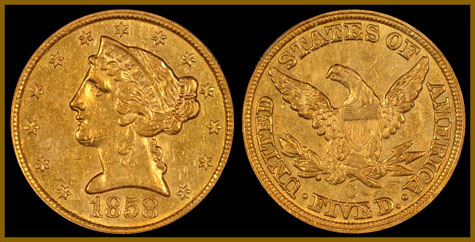
The Charlotte Mint opened
in 1838 to process locally mined gold. In 1844, a substantial
portion of this mint burned to the ground, preventing coinage
in 1845. In 1861, Confederate forces seized the Charlotte
Mint and shut it down, turning it into a hospital and headquarters
during the Civil War.
From 1867 to 1913, the building
housed a U.S. assay office. The building was later moved
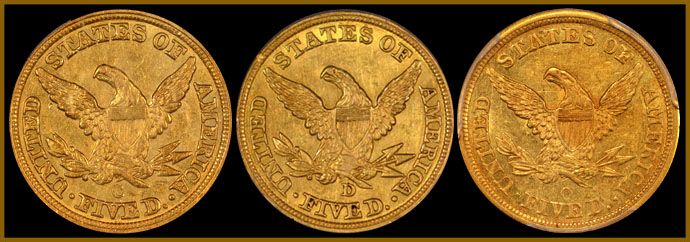
and currently houses an art museum. The mint-mark for Charlotte
is the letter C. The Charlotte Mint produced only gold coins,
usually of low mintage, not quite up to the standards of
the Philadelphia Mint, but generally better than the coins
produced at its sister facility in Dahlonega, Georgia.
Dahlonega,
Georgia (1838-1861)
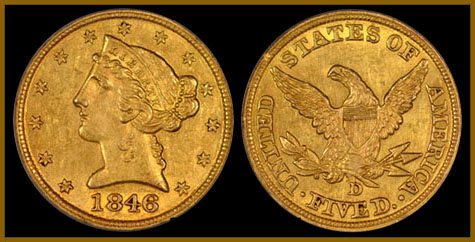
The Dahlonega Mint opened
in 1838 to process locally mined gold. Output at this mint
was always low, yet it continued to operate until 1861,
when Confederate forces seized the building at the outset
of the Civil War. In 1878, the Dahlonega Mint was destroyed
by fire.
Today, Price Memorial Hall
of North Georgia College sits on the original foundation
of the Dahlonega Mint. The mintmark for Dahlonega is the
letter D (the same as the Denver Mint, but the two mints
never operated simultaneously). The Dahlonega Mint produced
only gold coins, many of which were poorly made.
New Orleans, Louisiana
(1838-1909)
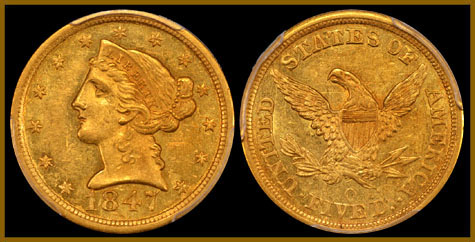
The New Orleans
Mint opened in 1838 to take advantage of the strategic port
location and the economic importance of the city, as well
as the availability of locally mined gold. In 1861, the
mint's operations were discontinued after it was seized
by Confederate forces, who used the building as quarters
for its troops. In 1862, Union forces recaptured the city,
eventually reopening the building as a U.S. assay office.
For a short time, the building
was used as a federal prison. In 1879, coinage resumed and
continued until 1909. Today, the building still stands on
the northeastern edge of the French Quarter, serving as
a branch of the Louisiana State Museum. The mintmark for
New Orleans is the letter O. The New Orleans Mint produced
both gold and silver coins, in varying mintages (rare to
common), generally of good quality, but often softly struck.