Quarter Eagles
- The two hundred and fifty cents or two dollars and fifty
cents coin is called the Quarter Eagle.
It derives its name from the ten dollar eagle coin. The
first issue was designed by Robert Scot and struck at the
mint in Philadelphia in 1796 and branch mints in Charlotte,
North Carolina from 1838 to 1859 (not inclusive); New Orleans,
Louisiana from 1838 to 1857; Dahlonega, Georgia from 1839
to 1859; and later in San Francisco from 1854 to 1879 and
Denver 1911 to 1925. At first it weighed 67.5 grains and
had a fineness of .9167. In June 1834, the weight and fineness
were changed to 64.5 grains and .8992; however, the Act
of January 18, 1837 changed the fineness to .900. Before
1834 few coins were struck. They are rare today because
of their low mintage numbers and high melting for bullion
because of their higher gold content. With the removal of
the United States from the gold standard, the denomination
was officially discontinued in 1933, but the last coin had
been issued in 1929.
Specifications:
Weight: 4.37 grams
Composition: .9167 gold, .0833 silver and
copper
Diameter: approx. 20 millimeters
Edge: reeded
The designs and designers of the
coins are as follows:
-
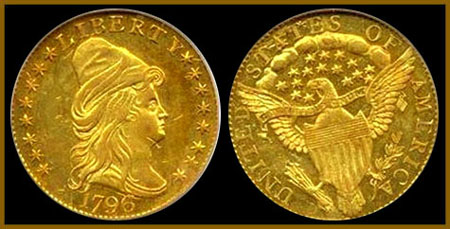
Turban Head or Capped
Bust to Right (1796 – 1807) – Robert Scot
-
Draped Bust or Capped
Bust to Left, Large Size (1808) – John Reich
-
Capped Head or Capped
Head to Left (1821 – 1834) – Robert Scot,
William Kneass
-
Classic Head or Classic
Head No Motto on Reverse (1834 – 1839) – William
Kneass
-
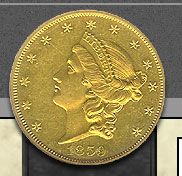
Liberty Head or Liberty
Head Coronet (1840 – 1907) – Christian Gobrecht
-
Indian Head (1908 –
1915, 1925 – 1929) – Bela Lyon Pratt
|