Flowing Hair Dollars - Scot’s
Flowing Hair Silver Dollar 1794-1795. Chief Engraver
Robert Scot designed the Flowing Hair Silver Dollar. It
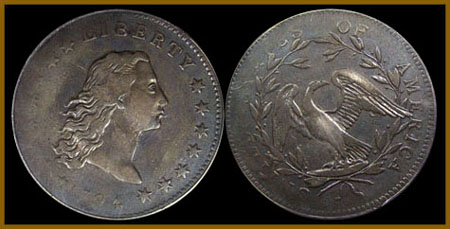
was issued from 1794 to 1795. It showed a portrait of Liberty
facing right with her hair loosely tied behind her head.
This feature evolved from the Flowing Hair Liberty portrait
that was featured on Joseph Wright’s Libertas Americans
Medal of 1783. Over time Liberty was turned to the right
and was shown without the liberty pole and cap. However,
the basic idea of Liberty’s hair free flowing is similar
to the earlier concept. Above her head is the word LIBERTY,
and the date is below. There are fifteen stars in accord
with the number of states that made up the Union in 1794,
eight to the left and seven to the right. The reverse, which
is similar to the Flowing Hair Half Dime and Half Dollar,
shows a perched eagle with wings spread looking to the right.
A wreath tied with a bow encircles the eagle.
The legend UNITED STATES OF AMERICA is in an arc around
the eagle. Except for its edge lettering, the coin has no
denomination-- something that might appear as a sign of
ineptitude on the part of early Mint employees to someone
familiar with United States coinage of the 21st century.
The omission was intentional, however, as United States
coinage was new to the world market of the 18th century
and the term “Dollar” would have been unfamiliar
to merchants of the day. Like European coinage of the time,
silver and gold pieces were valued by their weight and fineness
so the denomination was largely irrelevant. Prior to the
issuance of silver coinage, only copper coins were made
because neither the Chief Coiner, Henry Voigt, nor the Assayer,
Albion Cox, could post the $10,000 bond required to be responsible
for gold and silver. Thomas Jefferson recommended to President
Washington that this bond requirement be reduced. Washington
agreed, and in 1794 Scot was able to produce a die for the
cent, half dollar, and the dollar coins. Since there was
no standardized hubbing, individual punches were used for
numbers, letters, the stars, and leaf punches. The edge
was lettered HUNDRED CENTS ONE DOLLAR OR UNIT with decorative
designs in between the words.
It is estimated that about 140 to 150 examples
of the 1794 Flowing Hair Silver Dollar survive out of the
1,758 dollars that were struck on a hand-turned screw press
at the Mint in Philadelphia. The only day of production
for dollar coins that year was October 15th. They were made
from silver provided by David Rittenhouse, the Mint Director,
who wanted production to begin as soon as possible. The
early United States Mint was dependent on private deposits
of precious metals. Rittenhouse deposited $2,001.34 worth
of silver on August 29, 1794 so that silver dollar striking
could begin. Using Rittenhouse’s bullion and one set
of dies, 2,000 silver dollars were struck. Of these, 242
were found unacceptable and were either remelted or used
as planchets for the next year’s run. All 1,758 dollars
were delivered to Rittenhouse on October 15th, and it was
his responsibility to distribute the coins since he had
deposited the bullion.
Even those 1794 and 1795 Flowing Hair dollars
that were acceptable for distribution show many of the difficulties
the early United States Mint had with coinage operations.
Virtually all of the known examples are softly struck to
one degree or another at the left-obverse and reverse border.
This is due to the Mint’s use of a press that was
intended for smaller-size coins, as well as the fact that
the dies eventually “slipped” and became misaligned
in the press. Additionally, many 1794 and 1795 Flowing Hair
dollars display adjustment marks that represent the Mint’s
filing down of overweight planchets to make them confirm
to the legally specified weight range for this issue. While
these adjustment marks are often innocuous, as on the present
coin, they are sometimes so numerous as to severely compromise
one or more elements of a coin’s design.
Coin Collectors have pursued the 1794 silver
dollar from the earliest days of the hobby. It is the most
important and one of the rarest silver dollars. An example
of this date was featured in the first all coin auction
sale held in this country, the Roper Sale (M. Thomas and
Sons, February, 1851), lot 22, item number 4. The charisma
of this coin cannot be overemphasized. Many collectors choose
this date over the much less expensive 1795 dollar when
putting together a type set. Of course its position as first-date-of
–issue is but another reason for advanced collectors
to obtain this date. Regardless of striking quality or level
of preservation, a 1794 Flowing Hair Silver Dollar is extremely
important in numismatic circles, and the ownership of even
a low-grade and/or impaired example is the mark of an important
collection. Somewhat more common are the Flowing Hair Dollars
of 1795 with the original mintage of 160,295. Varieties
include Two Leaves, Three Leaves, and the Silver Plug.
Before the Revolutionary War, coins from
many European nations circulated freely in the American
colonies along with decimal coinage issued by the various
colonies. Chief among these was the Spanish silver dollar
coins (also called pieces of eight or eight reales) minted
in Mexico and other colonies with silver mined from Central
and South American mines. These coins, along with others
of similar size and value, were in use throughout the colonies.
They remained legal tender in the United States until 1857.
The dollar was intended to replace the Spanish, English,
Dutch and French coins that dominated the commerce of the
Confederation era. It was authorized on April 2, 1792 in
an act that also created the United States Mint and our
nation’s coinage. Because it was the Unit, the silver
dollar was the most important coin created and the basis
of the nation’s monetary system. All other coins struck,
and all paper money as well, are either fractional parts
or multiples of the dollar, and the Flowing Hair Silver
dollar was the first one made.
The
Flowing Hair design appeared on the first United States
Silver Dollars in 1794, but only lasted until sometime
in 1795, when it was replaced with the Draped Bust design.
The 1794 Silver Dollar is a rare coin, represented by
approximately 150-200 survivors. The 1795 Silver Dollar
is much more common, but the demand from type collectors
keeps the prices high.
The
usual numismatic rules do not apply to coins such as
this plugged silver dollar. When a plug is added at
the Mint to add weight to a light planchet, the coin
becomes one of the most eagerly sought Flowing Hair
type dollars. The use of the plug shows the early Mint’s
chronic shortage of high quality planchets. Its insertion
was used to bring the planchet up to specifications.
During the striking process, the plug was flattened
but remained discernible because it tended to tone differently
from the rest of the coin.