Proof Gold Coins
represent the ultimate in terms of beauty when it comes to
gold coins. No other manufacture or striking of coin can compete
with the beauty of a Deep Ultra Cameo Proof Gold Coin. Proof
Gold coins are considered among the best of the best of
all numismatic coins and actually go beyond numismatics and
are considered real art in metal form.
Rarity: Classic Proof Gold
Coins range from scarce to extremely rare. Some dates
in classic proof gold coins have single digit mintages.
Some proof gold coins have mintages in the hundreds
at most. Compare this with modern proof coins which have mintages
in the thousands-millions. It is therefore possible for a
collector or investor to own a quality proof gold coin,
with less than a couple dozen known for a few thousand dollars
and it is here where we can see the stability in such proof
gold coins.
There are extreme rarities in
the proof gold coin series that can be purchased for
as little as 5 figures which are finest known. Others which
are one of a kind numismatic proof gold coin rarities
run into the hundreds of thousands and millions of dollars.
Every investor, large or small can enjoy the ownership of
these great proof gold coins, and put a few of these
coins away for a rainy day or even help with a child's college
education. Shown here are hand picked examples of exquisite
proof gold coins, chosen for their rarity, eye appeal
and/or value.
United
States Proof One Dollar Gold Coins:
Beginning in 1854, proof one dollar gold coins were struck
almost continuously through 1889. Utilizing designs by Chief
Engraver of the Mint James B. Longacre, three distinct types
were produced.
These are the Liberty Head (Type
1), the Indian Princess Head, Small Head (Type 2) and the
Indian Princess Head, Large Head (Type 3). The original Type
1 pieces were a tiny 13mm in diameter and had to be modified
to better facilitate the minting process as well as to differentiate
them from small silver coins also in circulation. In 1854,
Type 2 pieces were issued and enlarged to 15mm.
On the Type 2, the obverse design
was changed to that of an Indian Princess but the height of
relief on the coin proved problematic and the design was again
modified in 1856 with the Type 3.
Reich’s
Capped Head Proof Quarter Eagle (1821-1834):
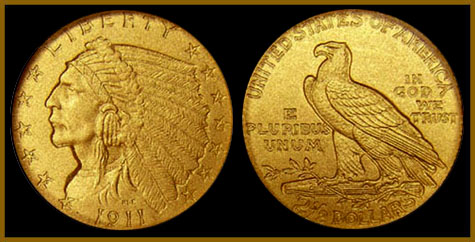
In 1808 John Reich designed a capped draped bust quarter eagle.
This one-year type is extremely rare and there was no proof
mintage. However, in 1821 Robert Scot, despite advanced age
and failing eyesight, designed a quarter eagle, which resembles
Reich’s earlier design.
The new Liberty faces left wearing a smaller
Phrygian cap inscribed with LIBERTY. She is surrounded by
thirteen stars with the date below. Because the effigy is
truncated at the neck, the head is larger than on the previous
issue. Also the stars form a complete arc above Liberty, unlike
the 1808 design where the cap interrupted them. The reverse
is similar to the 1808 issue. It shows a heraldic eagle facing
left holding arrows and an olive branch in its talons. The
legend UNITED STATES OF AMERICA is interrupted by the wing
tips and arcs above. The denomination 2½ D. is below.
The motto E PLURIBUS UNUM is on a ribbon that arcs from one
wing tip to the other. Dentils are near the edge on both sides
of the coin.
In 1823 Robert Scot died, and the Mint hired
William Kneass to take his place. Kneass was a bank-note engraver.
He was hired to improve the existing designs of all coinage
series. In 1829 he did this for the quarter eagle. The new
design had smaller stars, smaller letters, a redrawn Liberty,
and a redrawn eagle. It also had a high, plain raised rim
because of the use of a closed collar. The new collar imparted
a reeded edge and gave the coins a standard diameter. More
Details >>>
Longacre’s
Proof Three Dollar Gold 1854 to 1889:
In 1851 a law was passed that authorized a three cent piece
and also made the postage rate three cents. Two years later
a new law was passed authorizing a light weight silver three
cent coinage and three dollar gold coin. Evidently lawmakers
believed that the gold coin would be useful to buy rolls of
three cent coins and sheets of stamps. It’s closeness
to the quarter eagle, which was widely used, made the denomination
somewhat illogical, and the public proved indifferent to them.
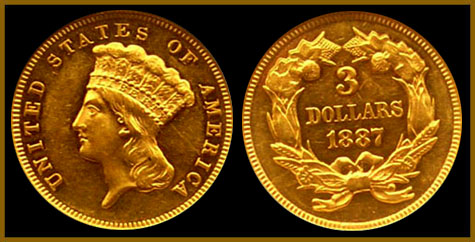
James Longacre designed the
three dollar gold coin using an Indian Princess motif. He
had to create a motif that would be distinctly different from
the quarter and half eagle coronet designs. The design, similar
to his Gold Dollar Large Head, shows a Caucasian Liberty facing
left wearing a stylized headdress. Inscribed on the headband
is LIBERTY. She is surrounded by the words UNITED STATES OF
AMERICA. In using the Indian Princess motif, Longacre felt
that he was designing something that was uniquely American
rather than an adoption from the classics. The reverse shows
an open wreath of corn, cotton, wheat, and tobacco tied at
the bottom with a bow. The denomination 3 appears at the top
center of the wreath, with DOLLARS and the date below within
the wreath. Longacre liked the wreath design so much that
he adopted it for use on the small cent of 1856.More
Details >>>
Stellas
1879-1880: The four dollar
“Stellas” were developed from the mistaken idea
that international trade would be facilitated if the United
States had a coin that was roughly the equivalent in value
to certain coins of other trading nations. It was felt that
the four dollar coin would be approximately equal to the Austrian
8 florins, Dutch 8 florins, French 20 francs, Italian 20 lire,
and Spanish 20 pesetas. This idea was mistaken because currencies
fluctuate in value. Also gold coins would be valued by their
weight and fineness not their denomination for international
trade. Nonetheless, John A. Kasson, the United States Ambassador
to Austria-Hungary, prevailed and convinced Congress of the
need for these coins.
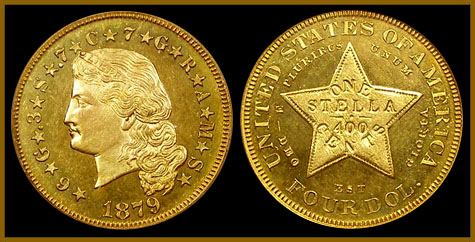
There were two types of Stellas.
The first was designed by Charles Barber. It is called the
Flowing Hair Type. It shows Liberty facing left with her hair
loosely tied behind wearing a band inscribed LIBERTY. The
words of the inscription 6 G .3 S .7 C 7 G R A M S separated
by stars surround Liberty. The reverse, which was common to
both types, shows a large five pointed star inscribed with
ONE STELLA followed by 400 CENTS. Surrounding the star are
the words DEO EST GLORIA and E PLURIBUS UNUM. UNITED STATES
OF AMERICA arc above the star and previous inscription, and
words FOUR DOL. are below. The second obverse type was designed
by George Morgan. It has the same inscriptions as the Barber
type, but Liberty is seen with her hair stylishly coiled.More
Details >>>
Reich’s
Capped Head Proof Half Eagles 1813-1834:
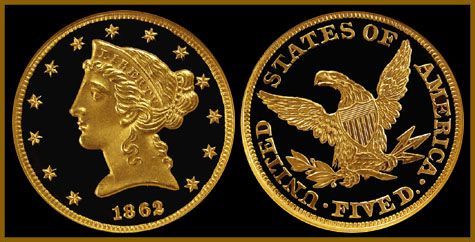
John Reich designed the half eagles of 1813 to 1834. They
are known as the Capped Heads. Only the 1813 to 1815 were
designed by John Reich. Although the 1818 to 1829 were done
by Robert Scott, he copied Reich’s earlier design.
The obverse shows Liberty
facing left wearing a cap inscribed LIBERTY. She is surrounded
by thirteen stars with the date below. Scott’s copies
were not nearly as artistic as Reich’s. Liberty’s
features are coarse and thick. His eagle is more defiant with
its opened mouth and aggressively curved neck. The heraldic
eagle is surrounded by the inscription UNITED STATES OF AMERICA.
Below is the denomination, 5 D. E PLURIBUS UNUM is on a banner
over the eagle’s head between its wings. Dentils border
both sides of the coin.
No proof mintage for this
series is listed in the Red Book, A Guide Book of United States
Coins. Obviously any that are seen are prohibitively rare.
The population reports of both grading services list 6 proof
coins in all conditions for all dates of this design type.
NGC has 1 for 1830 and 3 for 1833, and PGCS has 1 for 1832
and 1 for 1833.More
Details >>>
Scott’s
Proof Eagles 1795-1804: The
early eagle coins have no denomination because gold was valued
by its weight and fineness as was the European coinage of
the time. As seen on contemporary Large Cents, dentils are
at the edge of both the obverse and reverse of these coins.
The obverse design shows Liberty
facing right. Below her is the date which is off center to
the left. Between the date and the word LIBERTY on the left
side of the coin are eight stars. Another eight stars follow
LIBERTY down to the bust. (There were other arrangements of
the stars including ten and five, and twelve and four.) Liberty
wears a large, soft cap. Her hair flows down and also shows
on her forehead. The design was probably taken from a Roman
engraving of a Greek goddess. Liberty’s cap was certainly
not a Phrygian or liberty cap. The liberty cap, emblematic
of freedom, was worn by freed slaves and freed gladiators
in Roman times. It was a close fitting cap used to cover a
shorn head, which was one of the way slaves were identified.
The oversized cap worn by Liberty has been called a turban,
and the design has been called the Turban Head because of
it.
The Type 1 reverse shows a
rather scrawny eagle standing on a branch holding a wreath
in its mouth as it looks right. For some, the eagle looks
like a chicken with oversized wings. In an arc around the
eagle are the words UNITED STATES OF AMERICA.More
Details >>>
Longacre
Proof Double Eagles 1849-1907: The Double Eagle of 1849-1907 was
designed by James Barton Longacre. For all dates the total
proof mintage was 2,426 coins. Therefore, all proof double
eagles of this type are rare, and some are exceedingly rare.
With the Gold Rush of 1849
in California, there was a large increase in the amount of
gold coming into the Mint for coinage. Consequently, a bill
was introduced in the House to coin $20.00 denominations called
double eagles. Mint Director Robert Patterson tried to use
this new coinage bill as an excuse to terminate James Longacre
as the Engraver because of political and other differences.
The Chief Coiner, Franklin Peale, with Patterson’s approval
and help, was making medals on the side. Patterson was afraid
that Longacre would interfere with Peale’s profitable
business. Therefore, Peale would not cooperate with Longacre;
however, Longacre prevailed and was able to retain his position
and complete the dies for the double eagles.More
Details >>>
Saint-Gaudens’
Proof Double Eagles: Many consider
the Augustus Saint-Gaudens 1907 high relief Roman Numerals
double eagle to be the most beautiful United States coin ever
made. Reminiscent of the coins of ancient Greece, these coins
were designed by Saint-Gaudens at the behest of President
Theodore Roosevelt, his friend. Roosevelt felt that the contemporary
coinage was “atrociously hideous.” He had what
he called his “pet crime.” Now that he was president,
he could get rid of the ordinary look of the current coinage
and fulfill his dream of having a national coinage that would
be both beautiful and dignified. Saint-Gaudens, who created
his 1905 Inauguration Medal, agreed. “Whatever I produce
cannot be worse than the inanities now displayed on our coins.”
Unfortunately, Saint-Gaudens was in failing health and never
lived to see his new double eagles in circulation. He died
on August 3, 1907.More
Details >>>


























 United
States Proof One Dollar Gold Coins:
Beginning in 1854, proof one dollar gold coins were struck
almost continuously through 1889. Utilizing designs by Chief
Engraver of the Mint James B. Longacre, three distinct types
were produced.
United
States Proof One Dollar Gold Coins:
Beginning in 1854, proof one dollar gold coins were struck
almost continuously through 1889. Utilizing designs by Chief
Engraver of the Mint James B. Longacre, three distinct types
were produced.
 Reich’s
Capped Head Proof Quarter Eagle (1821-1834):
In 1808 John Reich designed a capped draped bust quarter eagle.
This one-year type is extremely rare and there was no proof
mintage. However, in 1821 Robert Scot, despite advanced age
and failing eyesight, designed a quarter eagle, which resembles
Reich’s earlier design.
Reich’s
Capped Head Proof Quarter Eagle (1821-1834):
In 1808 John Reich designed a capped draped bust quarter eagle.
This one-year type is extremely rare and there was no proof
mintage. However, in 1821 Robert Scot, despite advanced age
and failing eyesight, designed a quarter eagle, which resembles
Reich’s earlier design.
 Longacre’s
Proof Three Dollar Gold 1854 to 1889:
In 1851 a law was passed that authorized a three cent piece
and also made the postage rate three cents. Two years later
a new law was passed authorizing a light weight silver three
cent coinage and three dollar gold coin. Evidently lawmakers
believed that the gold coin would be useful to buy rolls of
three cent coins and sheets of stamps. It’s closeness
to the quarter eagle, which was widely used, made the denomination
somewhat illogical, and the public proved indifferent to them.
Longacre’s
Proof Three Dollar Gold 1854 to 1889:
In 1851 a law was passed that authorized a three cent piece
and also made the postage rate three cents. Two years later
a new law was passed authorizing a light weight silver three
cent coinage and three dollar gold coin. Evidently lawmakers
believed that the gold coin would be useful to buy rolls of
three cent coins and sheets of stamps. It’s closeness
to the quarter eagle, which was widely used, made the denomination
somewhat illogical, and the public proved indifferent to them.
 Stellas
1879-1880: The four dollar
“Stellas” were developed from the mistaken idea
that international trade would be facilitated if the United
States had a coin that was roughly the equivalent in value
to certain coins of other trading nations. It was felt that
the four dollar coin would be approximately equal to the Austrian
8 florins, Dutch 8 florins, French 20 francs, Italian 20 lire,
and Spanish 20 pesetas. This idea was mistaken because currencies
fluctuate in value. Also gold coins would be valued by their
weight and fineness not their denomination for international
trade. Nonetheless, John A. Kasson, the United States Ambassador
to Austria-Hungary, prevailed and convinced Congress of the
need for these coins.
Stellas
1879-1880: The four dollar
“Stellas” were developed from the mistaken idea
that international trade would be facilitated if the United
States had a coin that was roughly the equivalent in value
to certain coins of other trading nations. It was felt that
the four dollar coin would be approximately equal to the Austrian
8 florins, Dutch 8 florins, French 20 francs, Italian 20 lire,
and Spanish 20 pesetas. This idea was mistaken because currencies
fluctuate in value. Also gold coins would be valued by their
weight and fineness not their denomination for international
trade. Nonetheless, John A. Kasson, the United States Ambassador
to Austria-Hungary, prevailed and convinced Congress of the
need for these coins.
 Reich’s
Capped Head Proof Half Eagles 1813-1834:
John Reich designed the half eagles of 1813 to 1834. They
are known as the Capped Heads. Only the 1813 to 1815 were
designed by John Reich. Although the 1818 to 1829 were done
by Robert Scott, he copied Reich’s earlier design.
Reich’s
Capped Head Proof Half Eagles 1813-1834:
John Reich designed the half eagles of 1813 to 1834. They
are known as the Capped Heads. Only the 1813 to 1815 were
designed by John Reich. Although the 1818 to 1829 were done
by Robert Scott, he copied Reich’s earlier design.
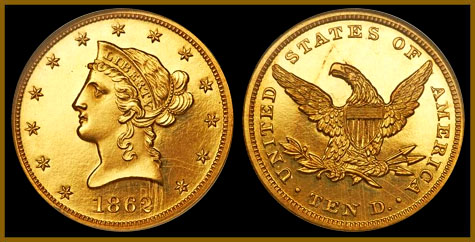 Scott’s
Proof Eagles 1795-1804: The
early eagle coins have no denomination because gold was valued
by its weight and fineness as was the European coinage of
the time. As seen on contemporary Large Cents, dentils are
at the edge of both the obverse and reverse of these coins.
Scott’s
Proof Eagles 1795-1804: The
early eagle coins have no denomination because gold was valued
by its weight and fineness as was the European coinage of
the time. As seen on contemporary Large Cents, dentils are
at the edge of both the obverse and reverse of these coins.
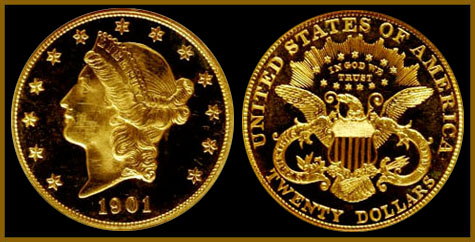 Longacre
Proof Double Eagles 1849-1907:
Longacre
Proof Double Eagles 1849-1907: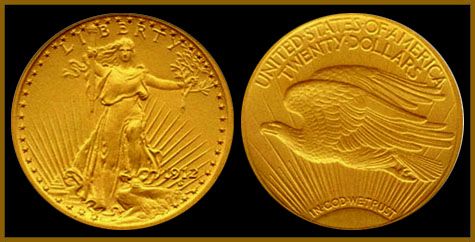 Saint-Gaudens’
Proof Double Eagles: Many consider
the Augustus Saint-Gaudens 1907 high relief Roman Numerals
double eagle to be the most beautiful United States coin ever
made. Reminiscent of the coins of ancient Greece, these coins
were designed by Saint-Gaudens at the behest of President
Theodore Roosevelt, his friend. Roosevelt felt that the contemporary
coinage was “atrociously hideous.” He had what
he called his “pet crime.” Now that he was president,
he could get rid of the ordinary look of the current coinage
and fulfill his dream of having a national coinage that would
be both beautiful and dignified. Saint-Gaudens, who created
his 1905 Inauguration Medal, agreed. “Whatever I produce
cannot be worse than the inanities now displayed on our coins.”
Unfortunately, Saint-Gaudens was in failing health and never
lived to see his new double eagles in circulation. He died
on August 3, 1907.
Saint-Gaudens’
Proof Double Eagles: Many consider
the Augustus Saint-Gaudens 1907 high relief Roman Numerals
double eagle to be the most beautiful United States coin ever
made. Reminiscent of the coins of ancient Greece, these coins
were designed by Saint-Gaudens at the behest of President
Theodore Roosevelt, his friend. Roosevelt felt that the contemporary
coinage was “atrociously hideous.” He had what
he called his “pet crime.” Now that he was president,
he could get rid of the ordinary look of the current coinage
and fulfill his dream of having a national coinage that would
be both beautiful and dignified. Saint-Gaudens, who created
his 1905 Inauguration Medal, agreed. “Whatever I produce
cannot be worse than the inanities now displayed on our coins.”
Unfortunately, Saint-Gaudens was in failing health and never
lived to see his new double eagles in circulation. He died
on August 3, 1907. 