Home
Newsletter
About Us
Coins For Sale
Selling Your Coins
Coin Collecting
Investing in Coins
Coin Information
Coin Articles
/World Coins
Books, Loupes etc.
Link to Us
Links
Contact Us
  Sign up for our free NewsLetter
  e-mail: 
  Sign Up 


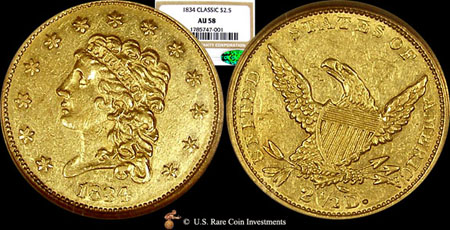
1834 QUARTER EAGLE CLASSIC HEAD TYPE
1834 Quarter Eagle. For several decades, the effect of enormous quantities of Mexican, Peruvian, and other Latin American silver reaching world markets had been increasingly to lower the price of silver in terms of gold, or in effect to raise the price of gold bullion (reckoned in Mexican dollars) to a point where U.S. old-tenor gold coins became worth more than face value. During the 1820s and early 30s, most Philadelphia gold coins went to bullion dealers, who promptly shipped them out for melting.
Archives documents of this period mention mass assays in Europe, in one of which (Paris, 1831) no less than 40,00 U.S. Half Eagle perished in a single melt. Something had to be done, and quickly. The expedient which finally managed to become law was a bill lowering the official weight of the Gold Eagle from 270 to 258 grs., and its quality from 11/12 (916.7 Fine) to 232/258 (899.225 Fine), with the Half Eagle and Quarter Eagle in proportion. This became law as the Act of June 28, 1834, effective August 1. Mint Director Samuel Moore correctly anticipated that enormous numbers of old-tenor gold coins (1795-1834) of all kinds would be brought in for recoinage, as the difference in bullion content made enough profit available to induce the public and the bullion dealers to bring the coins to the Mint rather than ship them overseas. In preparation for this flood of recoinage orders, Moore instructed William Kneass to prepare a large surplus of working dies for Half Eagle and Quarter Eagle, omitting the motto E PLURIBUS UNUM to enable instant identification: All old-tenor gold coins bore this motto, none of the new ones would show it.
Kneass, for reasons which may have had to do with uniformity of design in all denominations, chose to copy the old John Reich "Classic Head," first seen on cents 1808-1814, later on half cents and the new gold pieces bore this head rather than any other. Scot had replaced the Reich "Classic Head" on cents in 1816 by the "Matron Head," probably the ugliest head of Ms. Liberty ever to appear on a U.S. coin.
Though his reason i undocumented, we can make some plausible guesses. Recall first that Scot had been a bank-note-plate engraver in the 1780s, on the basis of which irrelevant skill he received the Mint engravership, November 1793.
During the decades flollowing, he had to learn to make device punches copying others's designs; but whenever he had to create his own, the result occupied a narrow range between banality and crudity.
Whenever Mint authoriteis hired an Assistant Engraver, the appointees found themselves professionally hampered, their best designs replaced by Scot's inferior ones as soon as possible. As early as 1807, Mint Director Patterson regarded as urgent the appointment of an Assistant Engraver to improve on Scot;s designs because Scot's advancing age made his capacity to do his own work increasingly dubious. For this very reason the Treasury approved hiring John Reich, who had been for six years vainly knocking at the Mint's door, despite two successive Directors regarding him as the best dieskinker in the United States. We may assume, then, that when Reich became Assistant Engraver and began creating new coin designs, Scot took this as an insult. This may have been why Reich received no raise in salary during 10 years of service; it may also explain why Scot replaced Reich's Half Eagle design in 1813 and his cent design in 1816.
Reich quit the Mint on the tenth anniversary of his appointment, ostensibly because of inadequate salary; but these personal rebuffs almost certainly loomed large in his decision, especially considering why Reich had been hired in the first place!
After Scot died in 1823, the next half cents to be issued bore not any new design (which they well might have), but Reich's old "Classic Head" portrait.
And so this androgynous effigy was hornored in 1834 by Kneass's choosing it for the new Quarter Eagles and Half Eagles. The flood of gold deposits anticipated by Mint Director Moore began that summer and increased during the next two years; issues of Quarter Eagles (beginning officially as of August 1) exceeded all exoectations. From then through 1839, over 910,000 came from Philadelphia bearing this design, plus some 57,475 from the newly built Southern branches at Charlotte, N.C., Dahlonega, Ga., and New Orleans, La., all with mintmark above date (1838 - 1839). The Philadelphia total for 1834 - 1836 alone is over 10 times the total old-tenor quarter eagle coinage.
With such large mintages, one would expect the coins to be available for a price; but any "Classic Head" gold coin in mint state is a rarity. These coins went into circulation at once and stayed there, few being saved as sounvenirs. Even the hoards discovered after WW II yielded virtually none in mint state.
Several design modifications followed. Coins of 1834 come with two entirely different heads; the first, called "Small Head," is instantly recognizable by the date's distance from lowest curls. The later one, called "Booby Head" by John H. Clapp before 1942, has 4 almost touching curl; it's effigy is no credit to Reich or Kneass; thick lips, jaw jutting forward, eye very deeply set. Coins of 1835 show a taller head with narrower bust, upper ribbon end almost concealed by a curl. In 1835, Kneass suffered a stroke, and Christian Gobrecht made later dies. Pressumably the 1846's with Head of 1834 and Head of 1835 were from dies completed earlier but with final digit omitted, whereas the Head of 1837 is Gobrecht's own modification. On this last, hair above brow slopes far back, very distant from sixth star. In 1838, Gobrecht replaced this head by a still cruder one imitating the "Booby Head," but larger with tiny stars; nor was his new version of 1839 any improvement.
However, with adoption in 1839 of the new Coronet Head concept (extended to quarter eagles in 1840), Gobrecht was to standardize the design: 67 years of stereotypy would follow five years of experiment.
1834 [All kinds 112,234 + 4 + P] Small head, large arrowheads.
Date far from curls; roll of curls on back of head almost straight. This obverse type discovered by Waldo Newcomer, described in John H. Clapp's notebooks, and first published by B. Max Mehl in the 1940s. Proofs have bases of E(S) and O repunched; at least 8 survive, mostly impaired (spent during the Hard Times?). On business strikes, repunching fades out.
1834 Small Head. small arrowheads. Very Rare. Same obverse; arrowheads distant from CA. Discovered by Newcomer about 1926.
1834 Large or "Booby" Head. 6 Reverses vars.
Large 4 very close to curl; deep indentation in curls at 2:30; thick lips, jutting law, eye more deeply set. Price for var. with split berry in branch. A M well apart; others are rarer. One Proof Known.


<< BACK


Have a question? Contact us here

Have a friend who might be interested?
Inform them about us now!
Your E-mail: Your Name: Friend's E-mail: Friend's Name:
Send to a Friend