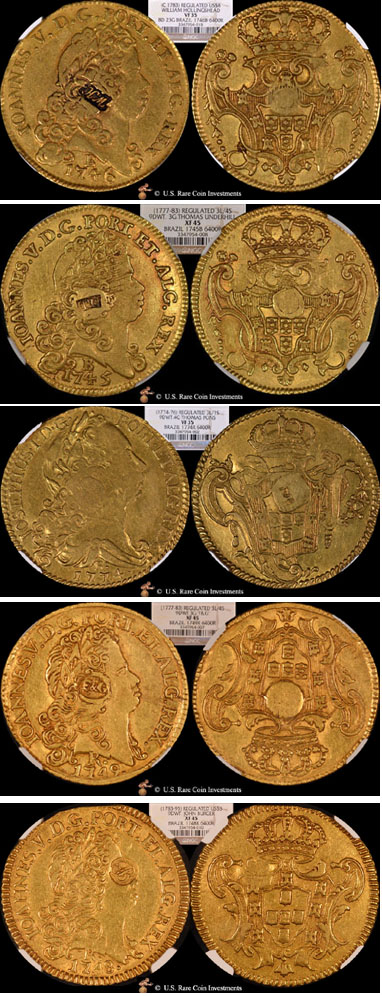
Regulated
Gold Coins - Article I, Section 8, Clause 5 of the Constitution
gives Congress the power to “coin money,
regulate the value thereof, and of foreign coin, and fix
the standard of weights and measures.”
This power was necessary in post-Revolutionary times because
gold
coins from many countries of the world circulated as
legal tender in the United States. They were valued for
their gold content not as specie. This cacophony of coins
of the world would be an obvious source of confusion in
domestic and foreign commerce. Coins from Brazil, Portugal,
Spain, France, and England all circulated concurrently.
However, each had a different weight and fineness making
trade extremely inconvenient.
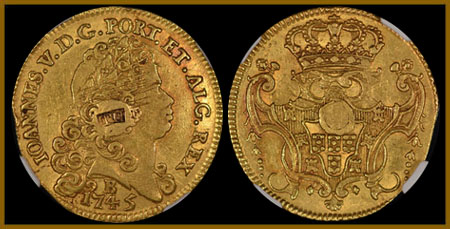
The problem was first dealt with in colonial
times, when coins were “regulated.” This practice
continued after Independence. A goldsmith or silversmith
would drill a coin and add gold in the form of a plug to
increase its weight. If it was then overweight, he would
clip and/or file its edge. Thus, coins were “regulated”
to certain standards. The plugs that were added were then
stamped with a hallmark indentifying the regulator who guaranteed
the gold content of the piece. Regulators, who were also
jewelers and highly thought of members of the community,
included John
Bayley, John
Burger, John
David Jr., Lewis
Feuter, Myer Myers, Thomas
Pons, Thomas
Underhill, and William
Hollingshead. However, none was so prominent and famous
in numismatic circles as Ephraim
Brasher.
When
a gold coin circulates, its weight can change. Honest wear
as well as dishonest practices cause changes in weight and
therefore value. Coins were clipped and sometimes a bag
of coins was “sweated.” It would be shaken and
the resulting dust and other gold residue would be accumulated
and later sold. So in addition to coins coming from different
countries, they might have had to be regulated because of
their diminished value as a result of wear, clipping, or
sweating.
Usually numismatists are concerned about
a coin’s pristine quality. In fact, today a “perfect”
coin is given a grade of Mint State 70. Coins that are holed,
clipped, filed, plugged, and counter stamped have considerably
diminished value to most collectors. Most coins in these
categories are considered undesirable and would not be certified
by any of the major grading services except in the “details”
category. However, in the realm of regulated gold
coins, all of the previous notions of quality and
appeal must be abandoned in favor of a different set of
assumptions. Even counterfeit coins have been regulated
and are highly collectible today. Obviously a regulated
coin cannot be in Mint State condition. The host coin must
be described in detail and, if possible, graded separately
from the plug or plugs.
Regulated
coins have been found in collections of famous
collectors and numismatists. These include Virgil M. Brand,
Louis Eliasberg, John J. Ford Jr., John Work Garrett, Waldo
Newcomer, and John L. Roper. Edward Roehrs had an excellent
collection of regulated coins that was
auctioned in 2010 at the ANA Boston World’s Fair of
Money.
It seems unusual to modern sensibility that
colonists and citizens of the early republic would have
silver tankards, beakers, and porringers; however, it should
be noted that these items represented a person’s surplus
wealth. Since there were no banks where a colonist could
keep hard money, they took all their surplus coins to a
silversmith and had them melted and made into useful objects.
Since paper money often depreciated, savings were safer
if invested in silver plate where they could also be useful
in the home. In case of a theft, silver could easily be
identified by the hallmark and engraving and recovered.
If cash were needed, the silver could be taken to a silversmith
and be reconverted into money. The silversmith had to be
a man of highest integrity because he was expected to turn
a certain quantity of silver plate into coin or the opposite.
Ephraim
Brasher of the famous Brasher Doubloon,
was a New York goldsmith, sliversmith, and jeweler. He was
also George Washington’s silversmith, neighbor and
personal friend. In the late 1870’s he struck gold
coins that were equivalent to $16 and equal in weight to
the Spanish doubloon. His EB hallmark is punched on the
coins.
Brasher was a respected and valued member
of the community. In a Coinage magazine article, March 1978,
“The Bicentennial,” David T. Alexander said:
“In the late 1700’s, silversmiths and goldsmiths
were particularly respected members of the community, often
acting as bankers, assayers, and authenticators of the Babel
of gold and silver coins of the world which circulated in
the bullion-starved colonies and the new republic.”
William
Hollingshead was a Philadelphia silversmith who conducted
business at the corner of Arch and Second Streets from 1754
until 1785. He was born on October 11, 1728 in Rocky Hill,
NJ. He married Elizabeth Harvey on February 26, 1748 in
Philadelphia. Hollingshead advertised in Philadelphia’s
Pennsylvania Gazette, offering his services to the public
as a gold and silversmith. In March of 1776 George Washington
purchased two dozen silver cups from Hollingshead and had
his family crest engraved on each.
Hollingshead’s silver was simpler
than the style that was prevalent in England, reflecting
the sober, simple and rigorous life in America. It was beautifully
proportioned with sturdy, clean lines. It was clearly designed
for practical, domestic purposes.
An example of his silver is a sugar bowl
which represents the inverted pear form which was fashionable
shortly before the Revolution and persisted into the early
classical period. He also made a little cream jug on three
legs. Like the sugar bowl, it is pear shaped. It has a scroll-cut
lip and double-scroll handle. Both pieces are engraved with
the monogram R A T suggesting that the two pieces formed
part of a tea set.
Thomas
Underhill was born on May 18, 1755 in Monroe, New York.
He married Elizabeth Thorne in 1779. From 1775 to 1786 he
worked in New York City as a silversmith. He was a partner
in the firm of Underhill and Vernon with John Vernon from
1786 to 1787. Underhill died in 1824. A set of 6 teaspoons
was recently auctioned. Made by Thomas
Underhill of New York City, they are marked “TU”
in a rectangular punch, much like the present coin.
Thomas
Pons was a Boston silversmith and spectacle maker. In
1757 he married Sarah Fosdick in Boston. Pons worked from
1782 until 1811 and was listed in the 1800 city directory
at 51 Newbury Street, the heart of Boston. By 1807 the Boston
city directory listed him as a “spectacle manufacturer.”
Three years later he declared his intention to make spectacles
in the March 28, 1810 edition of The Massachusetts Spy and
offered to lease or to sell his other business holdings.
His PONS is the earliest known American spectacle maker
marking. All of Pons’ regulated coinage is rare. He
is one of the few known silversmiths who worked and lived
in Boston in the post-Revolutionary period.
Lewis
Feuter - Lewis Feuter’s father, Daniel, was a
well known silversmith in New York who worked for the British
making peace medals. Father and son worked together in 1769,
but the son soon began running the business alone. F&G
always marked at the center, often with a big lumpy plug.
Feuter died in Jamaica in 1784 at the age of 38, just months
after the end of the British occupation New York. He had
left New York for Halifax, like many Loyalist evacuees,
before ending up in Jamaica and meeting his early death.
John
Burger was a New York silversmith who also regulated
coins for the new United States government. In 1786 his
address was listed as 207 Queen Street in New York City.
John
Burger was born in 1747 and died in 1828. He married
Sarah Baker in 1767 in New York City. They had two children,
Thomas and David. He was an apprentice to Myer Myers, a
leader in the New York Jewish community and ardent supporter
of the Patriot cause.
In 1775 he was a partner with Prichard,
and from 1779 to 1783 he partnered with Myer Myers.
From 1784 to 1805 Burger worked as a gold and silversmith
in New York City. He was a member of the Gold and Silver
Smiths Society of New York. Other members of this small
guild included Myer Myers and Ephraim
Brasher. In 1803 John
Burger was also appointed as Corner in New York City.
From 1805 to 1806 he worked with his sons, Thomas and David,
at 62 James Street. In 1825 he was appointed as Regulator
of Public Clocks in New York City.
The provision that allowed foreign gold
and silver to be used as legal tender in the United States
remained until the Act of 1857. It was then that the niche
that foreign coins filled ended. It is clear that America’s
dependence on foreign coinage was galling to Hamilton and
other Federalists. However, the demographic and commercial
success of the country in post-Revolutionary times made
it dependent on the gold of Brazil and other countries of
the Americas, and as long as these imports circulated, they
had to be regulated.




















 When
a gold coin circulates, its weight can change. Honest wear
as well as dishonest practices cause changes in weight and
therefore value. Coins were clipped and sometimes a bag
of coins was “sweated.” It would be shaken and
the resulting dust and other gold residue would be accumulated
and later sold. So in addition to coins coming from different
countries, they might have had to be regulated because of
their diminished value as a result of wear, clipping, or
sweating.
When
a gold coin circulates, its weight can change. Honest wear
as well as dishonest practices cause changes in weight and
therefore value. Coins were clipped and sometimes a bag
of coins was “sweated.” It would be shaken and
the resulting dust and other gold residue would be accumulated
and later sold. So in addition to coins coming from different
countries, they might have had to be regulated because of
their diminished value as a result of wear, clipping, or
sweating. 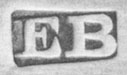 Regulated
coins have been found in collections of famous
collectors and numismatists. These include Virgil M. Brand,
Louis Eliasberg, John J. Ford Jr., John Work Garrett, Waldo
Newcomer, and John L. Roper. Edward Roehrs had an excellent
collection of regulated coins that was
auctioned in 2010 at the ANA Boston World’s Fair of
Money.
Regulated
coins have been found in collections of famous
collectors and numismatists. These include Virgil M. Brand,
Louis Eliasberg, John J. Ford Jr., John Work Garrett, Waldo
Newcomer, and John L. Roper. Edward Roehrs had an excellent
collection of regulated coins that was
auctioned in 2010 at the ANA Boston World’s Fair of
Money.