Information about all type of
US gold coins. We buy and sell Gold, Gold Coins. US Rare
Coin Investments is one of the largest gold coin dealers
in the United States specializing in Gold Coins.
The story of American gold
coins begins with gold itself. Gold was one of the first
elements discovered by Man, thanks to its distinctive, yellow
color and metallic luster. Gold is a relatively inert metal,
meaning that natural deposits enjoy a high level of purity.
Gold is most commonly found mixed with quartz as veins and
crystals, although other forms are known. Erosion of the
earth creates what are known as placer deposits, where gold
is exposed and concentrated in the form or dust, flakes,
and nuggets.....More
>>>
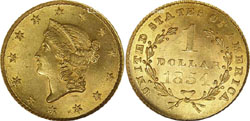 One
Dollar Gold Coins - Gold Dollars
One
Dollar Gold Coins - Gold Dollars
Gold has served as money or established
the monetary value of currencies longer than any other material.
The use of gold coins was widespread in Europe by the fourth
century B.C.
The earliest coins circulated in the United States were
foreign coins, mostly silver and gold, brought from Europe.
The Coinage Act in 1792 established an independent monetary
system with the dollar as the basic United States monetary
unit containing 24-3/4 grains of fine gold, based on the
world price of $19.39 a troy ounce (480 grains). Congress
changed the gold specification in 1834 and again in 1837,
when it set the dollar price of gold at $20.67 an ounce...More
>>>
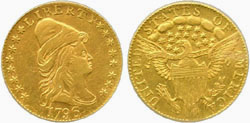 Quarter
Eagle Gold Coins - Quarter Eagles
Quarter
Eagle Gold Coins - Quarter Eagles
The Quarter Eagle was minted between 1796
and 1929. Early quarter eagle coins from 1796 to 1834 are
rare. They include the 1796 Capped Bust to Right, no stars;
the Capped Bust to Right with stars of 1796-1807; the Capped
Bust to Left, large size of 1808; and the Capped Head to
Left of 1821 to 1834. By 1834, the price of intrinsic gold
had exceeded the face value of the coins and most were melted
for a profit. In order to ameliorate this situation, the
Mint issued the Classic Head Quarter Eagle in 1834...More
>>>
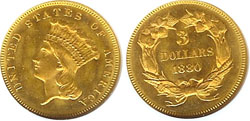 Three
Dollar Gold Coins
Three
Dollar Gold Coins
Indian Princess Head (1854
- 1889)
The three dollar gold piece was authorized
by the Act of February 21. 1853, First struck in 1854. the
coin was never popular with the general public and saw very
little circulation. Today, some numismatists theorize that
the $3 denomination would have been useful for purchasing
postage stamps of the day (with their face value of 3c)
or for acquiring 100 silver three-cent pieces ("trimes"),
which were also in circulation at the time. These gold coins
changed hands in the East and Midwest until 1861...More
>>>
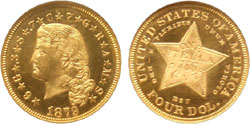 Four
Dollar Gold Coins or Gold Stella
Four
Dollar Gold Coins or Gold Stella
STELLA (1879 - 1880)
These pattern coins (Gold Stella - Four
Dollar Gold) were first suggested by John A. Kasson, then
U.S. envoy extraordinary and minister plenipotentiary to
Austria-Hungary. It was through the efforts of W.W. Hubbell,
who patented the alloy goloid (used in making another pattern
piece, the goloid metric dollar), that we have these beautiful
and interesting coins.
The four-dollar Stella-so called because of the five-pointed
star on the reverse-was envisioned by Kasson as America's
answer to various foreign gold coins...More
>>>
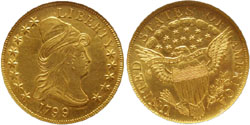 Half
Eagle Gold Coins - Half Eagles
Half
Eagle Gold Coins - Half Eagles
The half eagle was the first gold coin actually
struck for the United States. The five-dollar piece was
authorized to be coined by the Act of April 2, 1792, and
the first type weighed 135 grains, .9167 fineness. The Act
of June 28, 1834, changed the weight to 129 grains, .8992
fineness. Fineness became .900 by the Act of January 18,
1837.
There are many varieties among the early dates, caused by
changes in the number of stars and style of eagle, by overdates,
and by differences in the size of figures in the dates...More
>>>
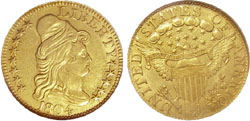 Eagles
- Eagle Gold Coins (Ten Dollar Gold Coins)
Eagles
- Eagle Gold Coins (Ten Dollar Gold Coins)
Gold Eagles were minted from
1795 to 1804, and then from 1838 to 1933. The gold eagles
began with a plump Liberty wearing a large cap, called Capped
Bust to Right, and, for the first three years, a scrawny
eagle holding a wreath in its mouth. Later in the third
year, the reverse was changed to a mistaken heraldic eagle.
The 1838 gold eagles corrected the heraldry errors and remained
without major modification until 1907. They used the familiar
Coronet or Liberty Head design and showed the denomination,
TEN D. The later years, from 1866 on, added a motto on a
ribbon above the eagle with the inscription IN GOD WE TRUST.
The final design of the gold eagles was the so called Indian
Head. The first issue 1907-08 had no motto. IN GOD WE TRUST
was added to the 1908 coin and continued thereafter...More
>>>
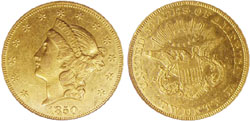 Double
Eagle Gold Coins - Double Eagles
Double
Eagle Gold Coins - Double Eagles
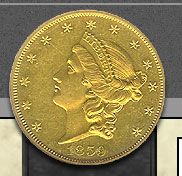
LIBERTY HEAD DOUBLE EAGLE
GOLD COINS (1849-1907)
Double Eagles - Aside from the World War I years, double
eagles were minted from 1850 (excluding the unique 1849
pattern) to 1933. Numismatists and collectors have always
been impressed with the double eagles because they contain
nearly an ounce of gold and also have a numismatic premium.
The first of the double eagles was designed by James B.
Longacre. It had no motto and the denomination written as
TWENTY D. The second of the double eagles added the motto
IN GOD WE TRUST to the slightly enlarge oval of stars on
the reverse. The third changed the denomination to TWENTY
DOLLARS. Longacre’s Liberty Head series ended in 1907...More
>>>
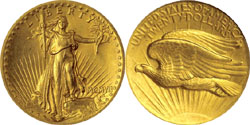 Saint
Gaudens Double Eagle Gold Coins - High Reliefs - Saint Gaudens
(1907-1933)
Saint
Gaudens Double Eagle Gold Coins - High Reliefs - Saint Gaudens
(1907-1933)
SAINT-GAUDENS TWENTY DOLLARS OR DOUBLE EAGLE
(1907-1933): The High Relief Saint Gaudens Double Eagles
have long been considered America’s most beautiful coin;
however, even the low relief coins that Charles Barber modified
have had lasting beauty and appeal. The modern Gold American
Eagle bullion program uses a modification of the Saint-Gaudens
double eagle low relief design, and it is exceedingly popular
with investors as a replacement for the Union of South Africa
Krugerrand...More
>>>
Gold and Gold Coins In The News - Articles on Gold
Coins
6/17/2009
- Gold sold like chocolate from German vending machines
6/12/2009
- Investors buy gold, as fears of inflation rise
6/08/2009
- Gold performing "incredibly well
6/08/2009
- Gold investment increasing, expert notes
6/01/2009
- Northwestern Mutual Makes First Gold Buy in 152 Years
(Update2)
6/01/2009
- PRECIOUS-Gold hits 3-mth high above $980/oz; $1,000 eyed
5/27/2009
- Aden Sisters: Gold is a good buy now!
5/19/2009
- Gold Buys Freedom
5/12/2009
- Get Out of Proof Gold American Eagles
5/04/2009
- Major Banks Buy Gold and Silver
4/20/2009
- Gold price could hit $1,500
4/13/2009
- What makes Gold Coins a good investment?
4/13/2009
- All That Glitters Is Not Gold
3/2008
- Feature Article: Time To Buy Gold?
3/30/2009
- Going For The Gold
3/26/2009
- New Gold Rush: Party Like It's 1849
3/14/2009
- Demand for gold coins soaring around the world
3/13/2009
- World Mints Report Soaring Demand For Gold Coins
3/02/2009
- Shipwreck Holds 200,000 Gold Coins
3/01/2009
- Why China wants to buy $93 billion worth of gold
2/20/2009
- Gold futures rise $1,000 on flight to safety
2/19/2009
- Gold Climbs As Economic Catastrophe Deepens
2/18/2009
- Stanford Coins - Stanford Coins and Bullion
2/17/2009
- Gold at seven-month high, up 3% on flight to safety
2/14/2009
- Rare Coins: A Distinct and Attractive Asset Class
2/10/2009
- Collecting Indian Gold $2.50 and $5 doable
2/2008
- Feature Article: SS Republic Coins Reveal Surprising Secrets
of 1861 New Orleans Half Dollars
1/28/2009
- Rare Coins Outperform Stocks and Gold Over 25 years
1/20/2009
- 2009 Double Eagle Gold Coin Brochures Mailed, Coin Sales
Begin Jan. 22
1/09/2009
- Merrill Lynch says rich turning to gold bars for safety
12/12/2008
- Prediction: Gold Will Rise in '09
11/18/2008
- Gold - The Six Biggest Myths About Gold
11/18/2008
- Governments Can't Handle Global Run On Gold Coins
09/25/2008
- Gold Coin Sales Halted After Retail Rush
More
Articles on Gold and Gold Coins >>>
What
is gold?
Gold is a chemical element with the symbol Au (from the
Latin aurum, meaning shining dawn) and atomic number 79.
It is a highly sought-after precious metal which, for many
centuries, has been used as money, a store of value and
in jewelry. The metal occurs as nuggets or grains in rocks,
underground “veins” and in alluvial deposits.
It is one of the coinage metals. Gold is dense, soft, shiny
and the most malleable and ductile of the known metals.
Pure gold has a bright yellow color traditionally considered
attractive.....More
>>>