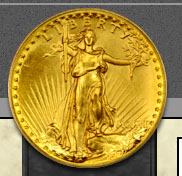
1879 $4 Flowing Hair, Judd-1635, Pollock-1833, R.3,
PR63 Cameo NGC. Patterson Du Bois, author of a January
1883 article, "The Pattern Piece," published
in the American Journal of Numismatics. His description
of such items, which is especially meaningful to $4.00
Gold Stella's is vivid and memorable:
"Open for me your cabinet of Patterns, and I open
for you a record, which but for these half-forgotten
witnesses, would have disappeared under the finger of
Time. Read to me their catalogue and I read to you,
in part, at least, the story of an escape from the impractical
schemes of visionaries and hobbyists--a tale of national
deliverance from minted evil."
Today, far from perceiving patterns as "deliverance
from minted evil," collectors consider them to
be fascinating detours from regular-issue coinage, often
with their own artistic and technical merits and they
have easily attained recognition on the book, 100 Greatest
Coins. In addition, while most such pieces are far from
readily available, a handful of patterns were produced
in sufficient quantity that they are considered collectible,
not only by pattern specialists, but by the general
population of U.S. coinage enthusiasts. The Flying Eagle
cents of 1856 are a famous example, and, among gold
coins, the 1907 Saint-Gaudens eagles with wire rim and
periods at E PLURIBUS UNUM are sometimes collected alongside
the regular issues. One widely collected pattern, however,
is not collected alongside any series, since it occupies
a singular place in the annals of American coinage.
That piece is the 1879 Flowing Hair stella.
Originally, the 1879 Flowing Hair stella was like many
other pattern issues, produced in highly limited qualities.
Pollock (1994) quotes research by R.W. Julian, published
in the November 1987 edition of The Numismatist under
the title "The Stella: Its History and Mystery,"
that claims that just 25 sets of three coins, each containing
an 1879 Flowing Hair stella, as well as an 1879 metric
dollar (Pollock-1813) and an 1879 goloid dollar (Pollock-1822),
were produced and distributed to Congress. A previous
estimate of only 15 sets appeared in Akers. The story
might have ended there, with the pieces winding up as
rarities in scattered pattern cabinets and generally
unappreciated by numismatists at large.
Congress, or more accurately, members of Congress who
saw the pieces and wanted examples of their own, intervened.
Early in 1880, the Mint struck off further three-coin
sets, which were then made available to legislators
at cost. A famous contemporary diatribe by S.K. Harzfeld,
described in Breen's Encyclopedia and elsewhere, noted
with some bitterness that the gift-giving of representatives
and senators had led to the patterns appearing in the
hands of "boarding house keepers" and women
of ill repute who operated out of Washington D.C's Bordello's
who fashioned the pieces into necklaces. The pieces
also attracted the attention of contemporary collectors,
who soon discovered that while Congressmen could obtain
the coins, they could not, except by working through
various agents who claimed Mint connections. In many
ways, this 19th century pursuit of the sets containing
the Stella cemented its reputation as very desirable.
Since a number of 1879 Flowing Hair Stella's are known
in various states of impairment, the search for an attractive
and well-preserved example can prove long and occasionally
frustrating. This delightful Choice specimen of the
$4.00 Flowing Hair Stella should prove a welcome change
to the discerning collector. Honey-gold, orange, and
wonderfully made, the Cameo contrast provides an incredible
visual appeal. In short, this is an astonishingly beautiful
survivor that merits a place in a world-class collection.
Don't
see it here? Tell us what you want Click
Here