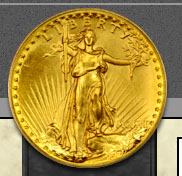
1912 $20 PR67 NGC. The U.S. Mint first
made matte proof gold coins in 1908. Despite earlier
criticisms from the collecting fraternity and collector
publications such as The Numismatist of the matte
proofs, after a temporary switch to the Roman Finish
or Satin Finish gold treatments in 1909 and 1910,
the Mint reverted in 1911 and subsequent years to
the much-maligned matte or sandblast finish. The recent
The Coinage of Augustus Saint-Gaudens as Illustrated
by the Phillip H. Morse Collection, published in 2006
by Ivy Press, notes of the 1912 issue that "sandblast
proofs are rare, regardless of date, and these pieces
were generally unappreciated at the time of issue.
The process of sandblasting these coins after striking
removed the 'bright' finish in the fields as seen
on the surfaces of the 1909 and 1910 issues. Instead,
thousands of tiny sparkling facets were present on
the surfaces of the coin, but the subtleties of this
new, European-inspired process were largely unappreciated
in this country. The unpopularity of the matte proofing
process is largely responsible for the smaller percentage
of survivors of proof double eagles of this design
when contrasted to those of the previous Liberty design."
The current NGC population data show a total of 53
proof 1912s graded, although there certainly appear
to be some statistical impossibilities occurring in
those data. Of the mintages recorded for the matte
proof twenties, 1908's is largest at 101 pieces, with
the 1911 at 100, the 1912 at 74, the 1914 at 70, the
1913 at 58, and the 1915 at 50. Yet the current combined
NGC-PCGS certified populations show 111 proofs of
the 1908 in all grades, or 110% of the original mintage!
The 1912 similarly shows a certified population of
75 pieces at both services, one coin more than the
total mintage nearly 100 years ago! The 1913 total
is even more ludicrous, with a combined total that
is 117% of the original proof mintage of 70 pieces.
Clearly, there exist numerous crossovers from one
service to another in the cited data, and it is undoubtedly
complicated by those who "crack out" and
resubmit the same coin numerous times in the hope
of obtaining a higher grade. In the already-pricey
world of proof gold, the large cluster of 29 PR66-graded
pieces at NGC--or perhaps submission occurrences is
a better term--could just possibly consist of 29 separate
coins, although that strains the credibility, as it
would mean that 40% of the original mintage survives
in that grade at just one of the two major services.
The figure could just as easily consist of seven separate
coins--five pieces submitted once each, and two coins
each submitted a dozen times. A glance at the PCGS
online Price Guide quickly confirms that a one-point
jump in grade easily equates to many tens of thousands
of dollars.
In the Superb Gem grade of PR67, there are 12 pieces
(or submission events) recorded at NGC, exceeded by
only a single PR68 piece (6/07). Again, a reasonable
estimate is that probably about 50% of those represent
duplications. At PCGS there are six coins certified
PR66, with none finer.
This piece, then, is high within the Condition Census
for the issue, and probably one of the half-dozen
or so finest specimens known. This piece is tied in
numeric grade as well as aesthetic appeal with the
exceptional PR67 that was in the Morse Collection.
The fields on each side are smooth and untroubled,
with a consistent mustard-yellow coloration. Close
inspection fails to reveal any post-striking impairments
that would help identify this piece in future auction
appearances. An exceptional piece of matte proof gold.
This one is sold. If you would
like us to find one like it for you or, if
you have one you would like to sell please contact
us.
Don't
see it here? Tell us what you want Click
Here