Home
Newsletter
About Us
Coins For Sale
Selling Your Coins
Coin Collecting
Investing in Coins
Coin Information
Coin Articles
/World Coins
Books, Loupes etc.
Link to Us
Links
Contact Us
  Sign up for our free NewsLetter
  e-mail: 
  Sign Up 


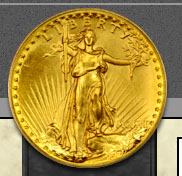
CARSON CITY GOLD
Carson City Gold. Unlike the design spacing on lower denominations, adding the motto IN GOD WE TRUST to the double eagle did not result in undue crowding of the design. Longrace, to fulfill the demands of Congress and Treasury Secretary Salmon P. Chase (but ultimately of the Revarse M. R. Watkinson, of Ridleyville, Pa., progenitor of the idea), slightly enlarged the oval of stars above eagle's head, inserting the motto within. This was, however, not the only alteration. The shield, formerly with straight sides now has rococo borders: the double scroll has smaller but more elaborate finials encroaching less on IBUS; leaves are differently shaped and there are nine rather than the former eight; wings are closer to both E's (in some dies appearing to touch, or joined by a pseudo-boder); tail closer to NT, requiring smaller mintmarks.
Most dates in this period show up oftenest in VF with S mintmarks. Philadelphia issues 1866 - 1872 are mostly scarce, except for the 1867 UNCs. from a hoard (possibly 2,000, found in Europe about 1966, distributed in the USA beginning about City issues 1870-1873. Authorities and bankers preferred to ship bullion to San Francisco, alleging lower cost. Claims (partly verified) that the CC Mint issued some lightweight and/or debased coins, 1871-1873, led to dismissal of the Superintendent, H.F. Rice. and to the frequently seen edge test marks on Carson City Gold Pieces of this period. This discovery gave ammumany who sought to have this branch abolished; but their real reasons had to do with who would get the coveted contracts for Carson City issues are dated 1874-1876, coined from local bonanzas. Other CC dates are all rare, and in mint state all but unknown.
Philadelphia issues of 1873 were larger because coined from melted obsolete issues; San Francisco issues 1874-1876 still larger CC-Mint output. Though EF's are plentiful, UNCs. are rare. How rare depends less on amunts coined than on the numbers recovered ca. 1953-1964 from French and Swiss banks.
There are two date logotypes for 1871 the same two as for silver dollars. On the earlier, 71 practically touch, with long serifs to 1's; on the later, 7 1 are spaced apart, with shorter serifs.
We know that the former came first because it appears on obverse shipped to branch mints in the fall of 1870, whereas that with 7 1 apart comes only on Philadelphia coins. Reason for the change remains unknown. On the other hand, reasonfor the change from "closed" to "open" 3 in 1873 is well documented.
William Barber, Mint Engraver, furnished a set of date logotypes for 1873 working dies, early November 1872. On the smaller denominations, the large knobs to 3's are so close together that these 3's are readily mistaken for 8's (as has repeatedly happened on shield nickels and gold dollars). Chief Coiner Archibald Loudon Snowden filed a formal complaint to Mint Director James Pollock, Januarry 18, 1873; Pollock ordered Barber to make a new set without this fault. On the double eagles, the distinction is fairly difficult: Closed 3 obverse have knobs approximately eaual in size, spaced closer together than the width of either knob; open 3 dies have upper knob noticeably smaller than lower, and they are farther on silver dollars; open 3 as on trade dollars. The 25 proofs and a latter were fromerly considered rare, but collectors learned how to identify them and retrived many in all grades. Carson City Coins all have closed 3, as do most San Francisco 1873's; the 1873 S open 3 remains rare.
In 1876, William Barber wished to improve on his predecessor's designs, but his project went only far enough to make two obverse, with respositioned head. The first of these was combined with a regular reverse die; the second with a new reverse reading TWENTY DOLLARS. Only one specimen of each is known. It is not absolutely certain wheter he found them among the holding of his father in law William Idler (the Mint's fence since the 1860s) or in the trunkful of pattern, experimental, and other nonstandard coins held by former Chief Coiner A. Loudon Snowden. This enomous group went from Snowden to Haseline for William H. Woodin, as part of the price to the Mint Cabinet Collection; he had bought them from Snowden Mint Cabinet Collection; he had bought them from Snowden for $10,000 apieces. This 1876 First Transitional went successively to Stephen K. Nagy (Haseline's agent and son in law), Woodin. Waldo Newcomer. F. C. C.Boyd, King Farouk, and Sprink's for a private collector. Other specimens may exist, mistaken for ordinary 1976's, or maybe simulated by gilt copper strikings. The latter will neccesarily be lightweight, probably less than half the 516 grs.= 33.436 gms. of a gold specimen.
Your interested in gold coins, Gold Dollars, Rare coins and rare gold is shared by millions of people in the USA and around the globe. Numismatist / Coin Dealer Tom Pilitowski has been providing expert and confidential service since 1979.


<< BACK


Have a question? Contact us here

Have a friend who might be interested?
Inform them about us now!
Your E-mail: Your Name: Friend's E-mail: Friend's Name:
Send to a Friend