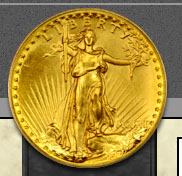
In commemoration of the
three hundredth anniversary of the founding of the Colony of
Connecticut a souvenir Half Dollar was struck.
This very Art Deco design represents the Charter Oak, vaguely
after one of C.D.W Brownell's four paintings of this historic
tree (completed in pictured in Slabaugh and Taxay), with a prominent
cavity in the trunk emphasized for historical reasons rather
than realism. (Realism would have made the leaves less than
one-tenth the size they are on the coin, compared to the trunk!
This tree was about 1,000
years old and some 21 feet around near the base before lightning
blasted it on August 21, 1856.) Use of this tree as a symbol
for Connecticut was inevitable: in 1662, King Charles II granted
the younger John Winthrop a royal charter for the colony; but
when James II succeeded to the throne, he sought to recall all
his predecessor's charters and to consolidate all the New England
colonies into the Dominion of New England colonies into the
Dominion of New England under Governor Sir Edmund Andros (1686).
Andros visited the colonial authorities at Hartford on October
31, 1687, and when at a meeting that evening he announced that
he intended to seize the charter and return it to the King,
all the candles were extinguished long enough for Joseph Wadsworth
to hide the charter in the oak tree's historic cavity.
Andros left, infuriated,
but powerless as long as he did not have that document. After
his patron James II was ousted in the "Glorious Revolution"
a year later, the colonists in Boston seized Andros and sent
him back to England in chains. The original charter was retrieved
(a fragment of which remains with the Connecticut Historical
Society), and the tree, ever since called the Charter Oak, became
an object of veneration. After lightning felled it, its would
was used for making various historical items, including the
chair still reserved in the Hartford State House for the President
of the State Senate. The Charter Oak Memorial stands today on
the site of the tree, at Charter Oak Avenue and Charter Oak
Place.
The Charter Oak, then, is a symbol of Connecticut's colonial
independence cut from the same bolt of cloth as the more ferociously
radical activist variety represented by the Sons of Liberty
in Massachusetts.
On the reverse, thirteen
stars for the 13 original colonies form a semicircular are around
the eagle, though they are so faint as not to be visible on
some strikings. This leaves only dates 1635-1935 unexplained.
Historians have long taken 1635 as the official date of foundation
of the Colony of Connecticut, mostly because in that year John
Winthrop the younger (later Royal Governor and recipient of
the charter from Charles II) had been named governor on the
strength of letters patent from the Earl of Warwick. There had
been Dutch settlers in the area for a generation before, and
English organized central government before Winthrop.
The Connecticut Tercentenary Commission (Samuel Fisher, chairman)
sought approval of an issues of commemorative half dollars in
connection with statewide celebrations to be held in 1935. The
bill to authorize the mintage became the Act of June 21, 1934.
The Fine Arts Commission
approved Kreis' models as of February 4, 1935; the Treasury
concurred on February 6, after which the models went to Medallic
Art Company for reduction. As the authorizing act specified
25,000 coins, the Philadelphia Mint struck that quantity in
a single batch, with 18 extra reserved for assay, during part
of April and May 1935. They went on sale through the Tercentenary
Committee at $1 apiece; the entire issue sold out and there
was no hint of scandal at any time.
Many of these coins went to the general public, and as a result
many of them are in none too satisfactory condition, being nicked,
scratched, or poorly cleaned. A critical area appears to be
the upper part of wing, legs, and claw pads; look for mint frost
if any of these are weaker than on the specimen pictured.
Matte proofs exist; the only one we have physically
handled is from the John R. Sinnock estate, via lot 2055,
1962 ANA Convention auction. Four or five others are reported.
As they could be fraudulently simulated by pickling or sandblasting
ordinary uncirculated specimens, we show an enlargement of
the authentic proof. No specimen with less detail sharpness
than this or with the same granularity within nicks or dents
as elsewhere in fields is acceptable.
The normal coins were distributed in small boxes
covered with silver foil, and bearing the state arms in dark
blue ink, one coin per box. About thirty of these original
boxes of issue survive; there are slight variations in the
state arms. Unfortunately, we have not had long enough access
to any of these to photograph the varieties. A fine philatelic
tie-in is the Connecticut Tercentenary or "Charter Oak"
3c stamp, Scott 772, Type A249. This comes in violet (one
variety being called rose violet) and its designer is not
credited. The tree is obviously based on the Brownell painting,
but this time minus cavity, enlarged leaves, or stylization.