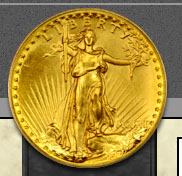
The 1861-O double eagle is one of the more fascinating
coinage issues in U.S. numismatics, reflective of
a time of deep division and discord in the nation's
political and social fabric. The Philadelphia Mint
shipped three pairs of dies to the New Orleans Mint
on Dec. 10, 1860, but only one pair was used. The
1861-O coins were issued under three distinct governmental
entities:
-
The federal government, which
struck 5,000 pieces between Jan. 1 and Jan. 26,
1861.
-
The State of Louisiana, which
coined 9,750 coins between Jan. 26 and May 31, during
which time Louisiana had seceded from the Union.
-
The Confederacy, which issued
2,991 pieces June 1 and thereafter.
The Breen Complete Encyclopedia (1988)
suggests that perhaps the pieces issued under the "rebels"
are those with the "greatest weakness at the base
of the date." If that’s true then it’s
apparent by the exceptional strike of the present specimen
that special care was taken when creating this coin
or that it was struck during the usual minting process.
However, Bowers has a different view in that that some
coins show hand-strengthening, in the form of three
V-shaped lines engraved at the base of the 8--a function
of the New Orleans facility's lack of numeral punches
for the job.
It is worth mentioning that this historic issue could
have been struck with the Paquet reverse--the distinctive
design promulgated by the underrated French engraver--were
it not for one simple fact: The telegraph existed to
communicate between Philadelphia and New Orleans, but
not to San Francisco. The Mother Mint had already shipped
dies to both branches, but when the striking difficulties
with the Paquet reverse became apparent, a telegraphed
message went out--in the case of New Orleans, directly,
but in the case of San Francisco, by telegraph to St.
Joseph, Missouri, and thence overland by Pony Express.
The present example in our view is considerably better
than a previous specimen sold at public auction (Sept
2006, realized $42,262.00) and nicer than almost all
other specimens seen in recent years with few exceptions.
This specimen also shows significant proof like reflectivity
on both obverse and reverse and a considerably better
strike than the majority of coins of this date and mintmark
that I have seen anywhere. Certainly a premium quality
choice about uncirculated obverse and the reverse appears
technically AU-58. Bowers summed this date up quite
nicely “Today the 1861-O is a rare and highly
sought after variety” and we will add that this
is quite a monumental find for the advanced collector
of Condition Census Southern Gold Rarities of all denominations.
|