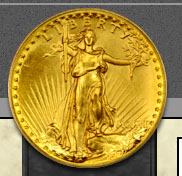
Less than a year after the "Type II" or Narrow Head Dollars went into circulation, all concerned knew that the design must be changed: Specimens were already coming back to the Mint for recoinage, some with the dates hardly legible. And many coins hot out of press had the same fault, adjust the presses as you will: weakness in centers so that obverses looked worn, dates blurry.
As soon as Longacre could be spared from completing the experimental dies for the 1855 bronze pattern cents, Mint Director James Ross Snowden ordered him to begin work on a modified design for the gold dollar. Diameter would remain the same: Snowden, only a few years later, referred to the "evident evil" of simultaneously having in circulation two coins of the same denomination but different sizes. But the obverses head not only had to be of lower relief, it had to be arranged differently to avoid placing relief areas opposite reverse relief details wherever possible. (This same technical requirement necessitated the shift in 1858 from Flying Eagle to "Indian" cents.)
Longacre's solution was to adapt the $3 coin design. On the new dies, legend was nearer border, head farther from letters and different in plumes' shapes, locations, and proportions. No impressions remain of experimental dies of this design. The new design was adopted January 1, 1856, remaining unchanged through the end of 1889, when the denomination was abolished. Mintage began with a small group using the half-dime date logotype with upright 5. For unknown reasons, the next two dozen reverses all had dates from the quarter-eagle logotype with slanting 5. Those of 1857 - 1860 were smaller in quantity owing to a financial panic, which caused bank failures, business closures, mortgage foreclosures, mass unemployment, and hoarding of all forms of bullion. Large mintages of 1861 - 1862 came partly from melted worn double eagles, but largely from among eight million melted small-size gold dollars. The outbreak of the Civil War rendered gold scarce. Associated New York City banks voted in Clearing House, December 28, 1861, to suspend specie payments for the duration; from then until about 1879 gold was hoarded as worth more than face value in greenbacks. During the war, silver and even nickel cents were hoarded; people quickly came to realize that four quarters or 100 cents would buy more groceries than a greenback dollar or any bank note whatever.
What little gold was coined mostly went to holders of certain bonds and to whichever overseas creditors would accept nothing else. From the collector's perspective, this means that most gold coins, 1863 - 1867, were scarce (many even rare) from the day of mintage, being limited issues destined mostly for export and probable melting aside from the tiny handfuls of proofs for collectors.
The exported coins began showing up in British, French, and Swiss banks after WW II; for which reason most surviving gold dollars of this period are in or near mint state. The major exception is moderately large mintage of gold dollars between November 1873 and December 1874, made from melted, outworn, or uncurrent gold coins of earlier decades. On January 18, 1873, Chief Coiner Archibald Loudon Snowden complained that date logotypes featured a peculiar 3 ("Closed 3") which could be readily mistaken for an 8. Punchmakers in the Engraving Department had to furnish a complete set of new date logotypes for all denominations ("Open 3"). The Coiner's fears proved well founded: As recently as 1961, several years after Harry Boosel publicized this document, I saw 1873 Closed 3 gold dollars, 3c nickels, and shield nickels being misdescribed in auction as "1878"!
Both 1873 and 1874 dollars come with full or partial LIBERTY no headband (sometimes only LIB, LI, or even a solitary L visible), or with no LIBERTY at all, a result of wear on the hub. William barber in 1874 raised another obverse hub from the master die of 1856, indistinguishable in detail from its predecessors. This served for the remaining low-mintage years through 1889, probably fewer than 50 working obverse in all. Numerous counterfeits of 1873 - 1874, mostly with only L or LI on headband, have come to light since the 1960s. Most are high-quality gold of full weight, being aimed at bullion dealers, investors, and speculators. The most dangerous, and one of the commonest, has an irregular lump obscuring the individual dots which normally make up the l. terminal tassel of wreath (about 11:00). Their legal status is moot; they are freely bought and sold as "bullion coins" overseas and among nonnumismatic gold dealers in the USA.
From the collector's perspective, the best fate for them is melting. Dangerous fakes, also in gold gold, exist for many of the rarer dates between about 1868 and 1878. Authentication is urgently recommended! Despite limited mintages of the Broad Head dollars 1879 - 1889 mint-state survivors are plentiful. Most of the [1,600] of 1880 went to hoarders; during the 1950s and 1960s, the holdings of Horace L. P. Brand, Charles E. Green, and others yielded hundreds of choice examples. Smaller hoards turned up of other dates in the period; all are available for a price. Worn survivors are very unusual, and apparently nonexistent for 1880, which almost always comes prooflike UNC. Type collectors have snapped up many of these, especially as the coins are attractive sharp strikings.
This denomination is also notable for unprecedentdly large mintages of proofs 1884 - 1889. More proof gold dollars were minted than silver minor proof sets; in 1889, [1,779P] gold dollars, compared with [711P] sets from cent to silver dollar. Many proofs of the mid - 1880s are routinely found nicked and scratched owing to incompetent handling by the Coin and Medal Clerk at the Philadelphia Mint. Breen {1977}, quotes the original complaint, which resulted in this clerk's dismissal.
For reasons never clearly explained, the Act of September 25, 1890 abolished the denomination. But as the Coinage Act of July 23, 1965 says: "All coins and currencies of the United States, regardless of when coined or issued... shall be legal tender for all debts," one might argue that this act restores the original legal-tender status to gold dollars, superseding the 1934 regulations which had demonetized gold.
Designer, Engraver, James Barton Longacre. MInts, Philadelphia (no mintmark), Charlotte (mintmark C), Dahlonega (D), San Francisco (S). Mintmark below knot. Physical Specification, Authorizing Acts, as preceding. Grade range, POOR to UNC. Not collected in low grades.
FINE: Earlobe visible; traces of detail in forelock and hair above and blow ear; few internal details to leaves, knot, and cotton bolls.
VERY FINE: Traces of detail on curled ends of feathers; partial internal details in major locks of hair, leaves, knot, and bolls.
EXTREMELY FINE: Tiny isolated rubbed spots only; partial mint luster.
UNCIRCULATED: No trace of wear.
NOTE: Beware counterfeits and coins with traces of solder
EXCEPTIONS: C- and D-Mint coins through 1861 show characteristic local weaknesses; 1873 - 1874 may lack part or all of LIBERTY. When in doubt, grade by surface.
1870 S Small "S" [ 3,000 ] Rare.
Early states show repunching on S, bulge within it; on later states, repunching fades and S looks filled. Possibly 40 - 50 survive, mostly EF to UNC. (a tiny hoard?) except for ex-jewlry items. McNally, Auction 81:1369, UNC. Two reverses dies shipped after May 14, received May 28, replacing 2 earlier dies (sent December. 1869) which lacked mintmark.